Norðurál
Norðurál Grundartangi ehf. is a producer of aluminum and aluminum alloys for the international market. The company’s operating license allows for an annual output of 350,000 metric tons of aluminum. The company has facilities at Grundartangi in West Iceland and Skógarhlíð in the capital, Reykjavík.
Norðurál Grundartangi is a private limited company owned entirely by Norðurál, a subsidiary of the US-based producer Century Aluminum. The Board of Norðurál Grundartangi is responsible for maintaining proper organization and operations, development of long-term objectives, and monitoring the day-to-day operations of the company.
Statement from the Managing Director
It can be stated that 2025 was a normal year for Norðurál’s employees up until the fourth quarter when a serious failure in the electrical transformers occurred, which led to the decommissioning of potline two and a decrease of the smelter’s production by about two-thirds. From the very beginning, it was clear that it would take a while to get new transformers delivered to Iceland, so it was clear that the blow would be severe. To shorten the potline’s downtime, work began immediately to see if it was possible to conduct an emergency repair for the failed transformers and use them temporarily, until the new ones arrived in the country. In cooperation with key transformer experts, both domestic and foreign, it was possible to get manufactured components to repair the transformers. The repair took a relatively brief time and after extensive testing, the transformers were put into operation in April. Work then began immediately to restart the pots in potline two, and the smelter is expected to be in full production by July 2026.
Following the failure, we immediately decided not to lay off any employees and Norðurál employees have been working in recent months to prepare the potline for restart. It is clear that the company would not be as well prepared to start production as it is today if it were not for the exceptional team that works at Norðurál. I am grateful for the strength and cohesion that has characterized the team in challenging circumstances.
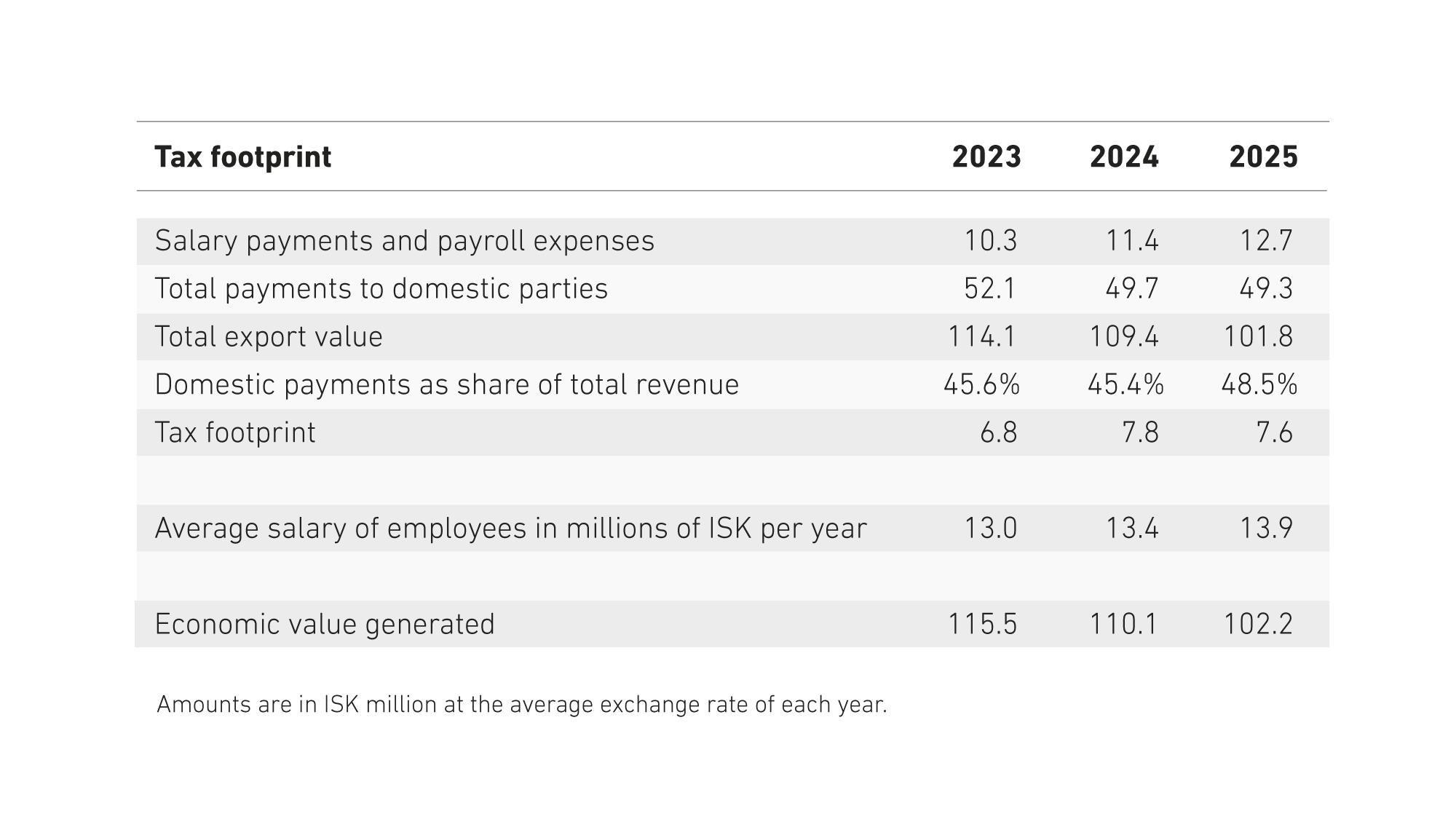
We continued to create value for Icelandic society despite the decline in production. Taxes and collected fees amounted to ISK 7.6 billion in 2025. Norðurál’s export value amounted to over ISK 102 billion, and payments to domestic parties were ISK 49 billion, or almost 50% of export values.
In 2025, we reached the goal that most of the aluminum produced by Norðurál were high-value products, such as billets and alloys. Production began in a new production line at the smelter where aluminum billets, formed by extrusion, are produced. The billets are in high demand by European customers, as aluminum is a key element in the production of electric cars, solar panels, aircraft, and sustainable buildings. In practice, value-added production, which until now has been conducted abroad, is being moved to Iceland. Until now, our aluminum ingots have been melted into billets in Europe, where electricity generation has a significantly larger carbon footprint than in Iceland. No additional CO2 is released through billet production at Norðurál, and the power requirements are significantly lower than if they were produced abroad. We calculate the power savings to be around 40%. This was an investment project of approximately 16 billion ISK and, due to its positive environmental impact, the project was financed with green financing from Arion Bank.
Climate issues are one of the key focus areas for Norðurál in its strategy and future value creation. The company produces aluminum with one of the lowest carbon footprints in the world and aims to be carbon neutral for our aluminum production by 2040. We have achieved a 57% reduction in emissions outside the ETS system compared to 2015. The initial target was a 40% reduction, and when that target was reached in 2024, the target was reset to a 55% reduction. The reduction in emissions per production unit is presently at 48%.
We continue unabated, work hard and are optimistic for the future.
The year 2025
Key figures from operations in 2025
Norðurál’s operating revenues amounted to approximately ISK 102 billion in 2025. The year’s performance was characterized by an unexpected failure in the smelter’s electrical equipment, which had a significant impact on the company’s production capacity and operations. Loss after taxes amounted to ISK 6.5 billion in 2025, compared to a profit of ISK 2.4 billion in 2024.
In October 2025, the aluminum plant’s electrical transformers failed, which temporarily reduced production by two-thirds. The consequences of the failure had a significant impact on the year’s production, and total aluminum production amounted to 260,155 tons in 2025, compared to 308,335 tons the previous year. Work is systematically ongoing to rebuild equipment, and it is expected that full production capacity will be restored in the summer months of 2026.
Despite these challenges, Norðurál continued to create value for Icelandic society. Norðurál’s tax path includes all major taxes and public charges that the company pays in Iceland, along with a counterpart contribution to the appropriate employee’s standard pension funds. The aim of the disclosure is to shed light on the extent of the financial contribution that Norðurál’s operations make to society in the form of statutory fees.
In addition to taxes and public charges, Norðurál creates extensive value in the Icelandic economy through payroll payments, transactions with domestic suppliers, and investments and support for community projects across the country.
Key figures from operations in 2025
Strategy, business model and value chain SBM-1
Norðurál has a clear strategy and business model based on responsible aluminum production with a low carbon footprint. Norðurál complies with our sustainability policy and Icelandic laws and regulations. The strategic priorities are in line with international standards and are reflected in the company’s goals in energy efficiency, waste management and workplace safety.
Norðurál uses 100% renewable energy from Icelandic energy companies and emphasizes environmentally friendly production and long-term cooperation with customers who demand responsible resource management. This gives the company the opportunity to support the circular economy and sustainability in the construction industry, car manufacturing and electricity transmission.
The value chain is shaped by environmental and social responsibility requirements, and sustainability is integrated into strategy planning, supplier agreements and customer service.
The company works systematically to:
- Minimize environmental impact, especially carbon emissions (with an emphasis on Scope 1, 2 and 3),
- Ensure the safety and well-being of employees and communities ,
- Produce aluminum with a low carbon footprint,
- Have a reliable and transparent partnership with suppliers and customers.
Strategy – Interests and views of stakeholders SBM-2
Creating long-term value in a sustainable and responsible manner, for the long term and with a positive impact on society, is at the heart of Norðurál’s corporate social responsibility. Our communication with stakeholders is based on a commitment to transparent and honest interactions, and this is an important part of the company’s continued success. Cooperation and procedures, including the frequency of cooperation, depend on the stakeholders and their nature. Communications take place according to a communications plan, and cooperation and construction projects are recorded in Norðurál’s management systems. Our suppliers and contractors must comply with Norðurál’s safety and environmental standards and code of ethics. We appreciate feedback from stakeholders and strive to respond to all queries.
For further information, please see S3-1, S3 SBM-2 and S3-2 under People and community
Material impacts, risks and opportunities and their interaction with strategy and business model SBM-3
The company’s operating results depend on the international market price of aluminum, which can be volatile and dependent on many factors beyond the company’s control. The sales price of aluminum depends on three components: (i) the basic price, which is based on the listed LME price; plus (ii) a premium that is added to the price when selling to Europe; and (iii) any value-added mark-up. Each of these three components has its own variability drivers. The price of aluminum is determined, among other things, by global supply and demand, inventory levels, speculation by market participants, what is being produced in global markets, political and economic conditions, and raw material and other production costs. These factors can be highly variable and lead to significant fluctuations in market prices.
Deteriorating global economic conditions may adversely affect demand and thus the price of aluminum. Any uncertainty, including escalation of regional conflicts, major public health issues or other unexpected events could lead to a decline in demand for aluminum. Such events may also cause disruption in operations, supply chain or affect the availability of labor.
A decrease in aluminum prices could result in a curtailment in production or actions to cut production costs, including the postponement of investment and maintenance projects and possible layoffs. Such measures could have an adverse effect on the company’s liquidity position, the ability to access loan capital and its operating results.
Electricity is one of the main factors in aluminum production costs. Consequently, the availability of electricity and its competitive pricing are important to Norðurál’s operations. Disruptions in electricity supply have a significant impact on the company’s operations and operating results.
Whereas payroll costs, tax payments and certain other costs are denominated in Icelandic krónur, the majority of our revenues are denominated in U.S. dollars. All these factors assume normal operations of the company. Adverse changes to these factors may have a considerable effect on the company’s operating results.
Whereas payroll costs, tax payments and certain other costs are denominated in Icelandic krónur, the majority of our revenues are denominated in U.S. dollars. All these factors assume normal operations of the company. Adverse changes to these factors may have a considerable effect on the company’s operating results.
Value chain challenges
- High carbon footprint of some inputs, particularly carbon anodes and bauxite.
- Technical and financial barriers to implementing circular solutions.
- Increasing demand from governments and buyers for transparency and traceability in the supply chain.
Value chain opportunities
- Growing demand for low-carbon aluminum, especially in Europe.
- Increasing value of traceable and environmentally friendly production – potential for green pricing.
- Increased use of recycled raw materials and development of eco-friendly production methods.
- Digital transformation and innovation, including the introduction of digital monitoring systems that improve measurements, traceability and efficiency.
Norðurál is working systematically to minimize the impact and utilize the opportunities through:
- A clear policy for carbon-neutral production using 100% renewable energy,
- Implementation of improvement projects in operations and processes (including recycling),
- Collaboration with suppliers on responsible purchasing and reduction of Scope 3 emissions,
- Defined measurable objectives and integration of sustainability into operational strategy and risk management.