Governance
The role of the administrative, management and supervisory bodies GOV-1
Norðurál operates according to clear and responsible governance principles that are based on applicable laws, international standards and guidelines from the parent company, Century Aluminum. The company’s Board of Directors is responsible for strategic planning and monitoring of operations and ensuring that operations and internal controls are in accordance with laws, rules and regulations. Emphasis is placed on transparency, sound decision-making and active interaction between the Board of Directors, Senior Management and key managers.
The Board of Directors holds supreme authority in Norðurál’s matters between shareholders’ meetings. The Board of Directors shall ensure that Norðurál’s organization and operations are in a good state. The Board shall also promote the development and long-term performance of Norðurál and monitor its daily operations.
The Board consists of John DeZee, Chairman of the Board, Gunnar Guðlaugsson, Hólmfríður Kristjánsdóttir, Robert Hoffman and Sigrún Helgadóttir.
The Board of Directors held a total of 4 board meetings in 2024. The meetings were attended by all board members, the Manager of Finance, and a representative of Century Legal Department and Company`s Legal Counsel.
The Managing Director carries out the daily operations of Norðurál in accordance with the policies and instructions of the Board of Directors. The Managing Director shall, among other things, regularly provide the Board of Directors with accurate information on Norðurál’s finances, structure, development and operations. The Managing Director shall at all times conduct his/her work with integrity and Norðurál’s interests at the forefront.
Gunnar Guðlaugsson is the Managing Director of Norðurál Grundartangi.
Organization Chart
Norðurál operations are divided into eight divisions that report to the Managing Director’s office.
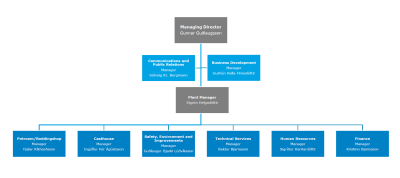 Detailed information on the company’s internal organization can be found here
Information provided to and sustainability matters addressed by the undertaking’s administrative, management and supervisory bodies GOV-2
Norðurál has established a clear structure for managing sustainability issues and disclosure in accordance with ESRS standards. The company’s Managing Director is responsible for the overall strategy and integration of sustainability into operations, together with the Executive Board, which has daily responsibility for implementation, follow-up and disclosure related to sustainability. The Managing Director and Senior Management are regularly informed about the status of matters, main challenges, opportunities and progress of improvement projects related to sustainability and social responsibility.
Sustainability Steering Group and ESRS Implementation
Norðurál‘s Sustainability Steering Group meets regularly under the chairmanship of the Managing Director. The group includes key executives, including the Manager of Safety, Environment and Improvement, the Manager of Communications and PR and the VP Sustainability at Century Aluminum, the parent company of Norðurál. The group oversees the implementation of ESRS metrics and ensures that sustainability measurements are valid, traceable and aligned with regulatory requirements. Its role also includes being responsible for data collection, implementation of metrics and duty of disclosure to stakeholders and regulators.
Safety, Health and Environment Committee
Norðurál’s Safety, Health and Environment Committee has an overall overview of the policy and objectives in safety, health and environmental matters and holds a key role in reviewing performance, monitoring and reporting. The committee is composed of representatives of the Executive Board, safety representatives and safety specialists. It meets quarterly and relies on the professional council of production staff and experts to mobilize broad participation in improvement projects.
The committee reviews metrics and reporting to regulatory bodies, such as the Environmental Agency and the Occupational Safety and Health Administration and provides regular summaries to the Executive Board and the Sustainability Steering Group.
Regular Monitoring and Information Sharing
Monthly environmental meetings, led by an environmental specialist, are held with the participation of the Executive Board and key departments. They review the main indicators of emissions, waste, operation of scrubbing equipment and quality of raw materials. Deviations are identified, improvement actions are defined as well as actions to create a culture of continuous improvement.
Weekly safety, health and environmental meetings are held with managers and experts, where safety incidents, environmental recommendations and improvement processes are reviewed.
Open information meetings are held annually with the Environment Agency of Iceland and monitoring bodies, where the results of monitoring are presented. Employees are regularly informed through internal media and department meetings about the results as well as the current focus on sustainability issues.
Integration of sustainability-related performance in incentive schemes GOV-3
Norðurál follows a clear sustainability policy that is reviewed annually and presented to staff on “inset days” and in regular internal training. In accordance with the company’s strategy and overall goals, each year measurable sub-goals are set in environmental matters, including as regards emissions, waste and education.
Progress on the goals is assessed quarterly at Executive Board meetings under the direction of the quality manager.
Performance in environmental and sustainability matters affects results-based payments. All employees are eligible for bonuses that are based on environmental performance, and for specialists, individual bonuses are linked to results in defined improvement projects.
Material impacts, risks and opportunities and their interaction with strategy and business model ESRS SBM-3
Norðurál‘s business model is based on aluminum production with a low carbon footprint using 100% renewable electricity. Sustainability is a key aspect of operations and has an impact on both the company’s strategy and risk management.
Norðurál operates according to certified environmental management in accordance with the ISO 14001 standard. Part of that system is a regular environmental impact assessment where the key impacts of operations on the environment are identified and prioritized according to scope and risk. The environmental aspects with the highest scores are defined as material and reviewed annually; other aspects are re-evaluated at least every three years. The assessment is carried out in collaboration with employees from all key departments.
The company also maintains a process within integrated management systems to analyze internal and external factors and stakeholder priorities in accordance with ISO 9001. These assessments support enterprise risk management, in addition to forming the basis for the development of objectives and improvement projects.
During the year, a double materiality assessment was conducted with the involvement of key stakeholders and consultants. It assessed the impact of Norðurál’s operations on people and the environment, as well as the impact of sustainability issues on the company’s performance and future position. The assessment revealed the main sustainability risks and opportunities and was used to prioritize the company’s sustainability plan.
The results of the environmental factor analysis, stakeholder analysis and double materiality assessment are summarized annually and discussed at an Executive Board review meeting. They shape actions, policies and measurable targets in sustainability issues and are a prerequisite for a continuous improvement culture in Norðurál’s operations.
Description of the processes to identify and assess material impacts, risks and opportunities ESRS 2 IRO-1
Norðurál is implementing processes to identify and assess significant sustainability risks, negative and positive impacts and business opportunities related to sustainability. This work supports both the company’s strategy and the requirements according to ESRS for reliable and transparent disclosure.
When assessing impacts and risks, Norðurál uses the following analytical methods:
- A double materiality assessment in collaboration with Langbrók Consulting, in which the impact on society and the environment on the one hand, and the impact on operations on the other, were assessed with the participation of key stakeholders.
- A stakeholder analysis, where stakeholders were prioritized.
- An environmental aspect and impact analysis according to ISO 14001.
- An internal risk analysis based on the COSO and Sarbanes-Oxley frameworks (as part of Century Aluminum’s corporate governance system).
- An analysis of external impacts and the regulatory environment, including the ETS system and carbon price developments.
- Opportunities for innovation and technological advancement in the development of circular processes and recycling.
Norðurál also performs a sensitivity analysis of key variables in the operating environment related to sustainability, to assess the potential financial impact of changes in electricity prices, raw material costs and carbon taxes.
The analysis supports decision-making and prioritization of investments related to energy transition, carbon neutrality and the circular economy, and is part of our integrated risk management.
Further information is to be found on the General Disclosure page, under Description of the processes to identify and assess material impacts, risks and opportunities ESRS 2 IRO-1.
Statement on due diligence GOV-4
The Board of Directors of Norðurál ehf. and the Executive Board are ultimately responsible for the content and reliability of the sustainability information presented in this report, in accordance with the ESRS standards under the EU Sustainability Reporting Directive (CSRD).
The Board of Directors oversees the integration of sustainability into the company’s strategy and entrusts the Executive Board with the implementation and follow-up of sustainability objectives and reporting. Norðurál‘s Executive Board is responsible for ensuring that reporting and measurements are based on internal quality standards, ISO certified systems and data collection from the company’s operational, safety and environmental systems.
Systematic effort is made to increase the integration of sustainability aspects in risk management, investment decisions and financial information, in accordance with the process requirements of ESRS IRO-1 and DR 1–3.
Disclosures in relation to specific circumstances ESRS BP-2
The operations of Norðurál ehf. in Grundartangi are carried out within the international Century Aluminum Company group and take into account both Icelandic law and international regulations on good governance, internal control and risk management. Foreign ownership has partly shaped the company’s approach in these matters.
Governance and legal framework
The parent company issues guidelines on governance that are used by Norðurál’s Board of Directors. Norðurál also operates in accordance with various laws and regulations, such as:
- Acts on annual accounts, private limited-liability companies, competition, hygiene and pollution prevention,
- The Personal Data Act and Money Laundering Act,
- The operating license from the Environment Agency,
- International obligations, such as the Paris Agreement.
Internal control and audits
Norðurál’s Board of Directors is responsible for internal control and active risk management, which is based on recognized standards, such as COSO and Sarbanes-Oxley (in connection with the parent company’s market listing in the United States). Deloitte and EY perform audits of internal control in connection with consolidated accounts.
There were two audits of ISO9001, ISO14001 and ISO45001 during the year. In the former audit, three minor deviations and twelve opportunities for improvement were identified. The second audit revealed five deviations and thirteen opportunities for improvement. The results of audits together with analyzes of deviations and follow-up with preventive actions and opportunities for improvement can be found in Norðurál’s suggestion and audit systems. The next external audit is scheduled for May 2025 and again in December 2025.
In April 2024, the Occupational Safety and Health Administration conducted a regular inspection visit, which included a discussion of Norðurál’s plan for safety and health in the workplace. In June, the Occupational Safety and Health Administration conducted an inspection visit to inspect Norðurál’s new production line. During that visit, recommendations for improvements were made that have already been fully addressed. The Environment Agency conducted a regular inspection visit in June 2024. During that visit, Norðurál’s contingency plans were also reviewed. The visit revealed a discrepancy regarding excessively high levels of fluorine in air quality measurements at Kríuvarða. Norðurál has submitted a remediation plan that has been approved by the Environment Agency and is being implemented.
Zurich, Century’s insurance company, conducted its annual review in September. One new comment resulted from the audit and two comments from previous audits are in progress. In addition, there was an IST85 certification audit and two ISO certification audits.
Response and management system
The company uses an integrated management system where incidents are recorded in an electronic system, analyzed and followed up with improvement actions. Contingency and response plans are in place and are reviewed regularly. Consultation with the Safety and Environmental Committee, which meets quarterly, ensures a connection to daily operations.
Norðurál has implemented robust risk management processes where the company’s risks are classified into four main categories:
- Business risk: Fluctuating aluminum prices on the world market, fluctuations in demand, and international competition.
- Financial risk: Currency risk where revenues are in USD but a large part of costs are in ISK (salaries, services, taxes).
- Operational risk: Fluctuations in the price and availability of electricity, alumina, electrodes and other key raw materials.
- Environmental risk: Potential environmental accidents, carbon taxes, changes in regulations or operational disruptions due to natural hazards.
Risk management and internal controls over sustainability reporting GOV-5
Norðurál has implemented robust risk management processes and the company assesses that its main risks are: Business risk, financial risk, operational risk and environmental risk. The Board of Directors and Norðurál’s Executive Board regularly receive risk reports addressing the major risks Norðurál is exposed to.
A Sustainability Steering Group within Norðurál manages the implementation of ESRS metrics and annual and sustainability reporting. Data is retrieved from Norðurál’s operational systems, including electricity consumption, emissions, accident registration, suppliers and human resources data.
Business unit managers are responsible for ensuring the accuracy, traceability and compliance of data with defined metrics.
The Board of Directors and the Executive Board receive regular analytical reports on risks and impacts on the operations.
Corporate culture and business conduct policies G1-1
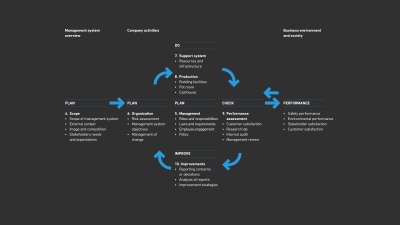
Norðurál’s management system consists of various factors, including a quality handbook containing procedures and guidelines as well as a feedback system to record incidents and comments. Comments are followed up on by preventive measures and opportunities for improvement. The management system extends to all Norðurál operations, including both staff and contractors.
Norðurál operates in compliance with laws on financial statements, private limited companies, hygiene and pollution control, privacy, and money laundering, as well as general labor laws and national laws. The company fulfills the requirements set in its operating license, complies with environmental laws and regulations, and has signed the Paris Agreement on reduced emissions outside the ETS system.
Great emphasis is placed on the quality awareness of employees and staff involvement in matters relating to the environment, safety, health, and human rights.
Mission
We produce aluminum responsibly that meets customer needs.
Vision
We create value that enables our customers, employees, shareholders and society to thrive.
Values
Care
We return home safe every single day because safety always comes first. We are all in this together. We take care of our people, communities and the environment.
Economy
We work efficiently and focus on what is important. With strong teamwork, we overcome obstacles and encourage continuous improvement.
Integrity
We are a responsible citizen in the community and have the courage to do what is right.
Excellence
We are a leading company and produce excellent products in a competitive manner.
Description of the processes to identify and assess material impacts, risks and opportunities IRO-1
Norðurál places great emphasis on analyzing and assessing the main sustainability impacts, risks and opportunities in its operations. The process is based on operational data, sustainability measurements, stakeholder dialogue and ISO-certified management systems. That way, we ensure that sustainability is integrated into the company’s decision-making, planning and improvement efforts.
A double materiality assessment was carried out in collaboration with the consulting firm Langbrók, where key stakeholders assessed the company’s most important sustainability aspects. At a strategy meeting with the Managing Director and steering committee of Norðurál, a stakeholder analysis was conducted that was based on the parties’ sustainability focus, common interests, risks and opportunities. Stakeholders were prioritized by importance. Interviews were conducted with customers, suppliers, municipalities and the parent company Century Aluminum. The results of the assessment reflect the importance of sustainability issues from both the perspective of society and the company (double materiality). It analyzes the impact of the operations on people and the environment, and the impact of sustainability factors on the company’s operations.
The results are used as a basis for prioritizing in Norðurál’s sustainability plan and are used to support risk analysis, the formulation of measurable goals and the development of disclosure in accordance with ESRS standards. The goal is for the integration of sustainability issues to become an increasingly strong criterion in the company’s strategy and daily decision-making in accordance with the requirements of ESRS IRO-1.
Management of relationships with suppliers G1-2
Norðurál is working on the implementation of procedures and criteria in supplier management. Supply chain management is an important part of ensuring a responsible value chain, both environmentally and socially.
Norðurál wants to set clear requirements for suppliers regarding ethics and social responsibility. Efforts are underway to increase transparency and accountability throughout the company’s value chain and we have begun implementing processes to better assess risks and opportunities related to collaboration with suppliers.
Main elements of supplier management:
- Requirement for signed supplier terms.
- Assessment of suppliers related to Norðurál’s production process.
- Obligations of suppliers to comply with laws and collective agreements.
- Use of special assessment processes for products/services in areas where laws and regulations in accordance with Norðurál’s requirements are not clear or effective.
Business relationships and liability (compliance) G1-3
Norðurál has not appointed a company compliance officer, but within the parent company, Century Aluminum, there is a department that handles compliance for subsidiaries. Internal audit is supervised by Century Aluminum’s Internal Audit Department. Moreover, KPMG conducts an annual audit on a consolidated basis.
Norðurál builds long-term partnerships with customers, suppliers and other business partners based on:
- Transparency, consistency and a clear division of labor,
- Written contracts with provisions on liability, quality, and social and environmental responsibility,
- Active monitoring and regular communication with partners,
- The involvement of experts, the Steering Committee and the Executive Board in assessing risks and opportunities within the value chain.
Confirmed incidents of corruption or bribery G1-4
Norðurál’s parent company, Century Aluminum Company, and its subsidiaries are committed to ethical behavior and comply with the laws around the world. US and international laws and regulations prohibit corrupt business practices, e.g. abnormal facilitations and misrepresentations in accounting and other data.
Detailed policy documents establish standards and protocols to ensure the satisfaction of legal and social requirements for the ethical conduct of an honest and reputable company.
Code of conduct
Century Aluminum Company, Norðurál’s parent company, and all affiliated companies are committed to complying with the strictest requirements for honesty, ethics and integrity in business. All members of management are signatories to the company Code of Ethics and committed to maintaining the company’s high standards of honesty and integrity.
No employee may promise, give, or accept payments in cash or other valuables, whether personally or through an intermediary, to parties public or private, or to a spouse, partner, or child or other relative of such a party, for the purpose of influencing or rewarding the actions or decision-making of such parties, or to gain any undue advantage.
In the same way, employees and their immediate family may not demand, accept or receive payments or other valuable directly or through third parties in excess of normal business practice.
Stakeholders and employees can report suspected violations to the Compliance Officer (generalcouncel@centuryaluminum.com) or anonymously through an independent third-party reporting system, Ethical Advocate. Reports may be submitted 24 hours a day, 7 days a week, by calling the number 800 9610. Following a notification, an internal investigation is launched.
We require all Norðurál suppliers and partners, whether customers, contractors, agents, or consultants, to act with integrity and be honest in their business transactions.
Norðurál is an ASI certified company which involves that aspects such as the working environment and employee rights, as well as ethical obligations, are reviewed. Audit results can be found on ASI’s home page
Political influence and lobbying activities G1-5
Norðurál does not support political parties or politicians. Relations with governments are based on disclosure as appropriate.
Further information on stakeholders can be found in S3-1, S3 SBM-2 og S3-2 under People and Community.
Payment practices G1-6
Norðurál pays invoices for goods and services before the end of the month after the costs were incurred, provided that the invoice is delivered no later than the 5th working day of the month. See more here.