
General Disclosures
General basis for preparation of sustainability statements ESRS BP-1
Norðurál ehf., a subsidiary of Century Aluminum Company, operates an aluminum smelter in Grundartangi in the western region of Iceland, where aluminum with a low carbon footprint is produced. The company only uses renewable electricity from hydroelectric power and geothermal energy for the production, and the company’s products are sold in international markets, mainly to the automotive industry, the construction industry and the electricity sector.
Norðurál’s business model is based on efficient and low-carbon aluminum production, and sustainability is increasingly integrated into the company’s strategy. This development reflects both the growing expectations of stakeholders and the changing competitive landscape of the aluminum market, where the emphasis on carbon footprint, traceability and social responsibility is increasingly important.
Norðurál’s management system and main sustainability focuses are:
- Climate – Minimization of greenhouse gas emissions (Scope 1, 2, and 3),
- Responsibility towards employees, safety and occupational health and safety,
- Environmental management and eco-friendly production methods,
- Responsible management of the value chain and supplier network,
- Transparency and improvements in governance.
Norðurál operates under an integrated management system that covers all aspects of the operation, including quality, environmental issues, occupational health and safety, social responsibility and management information.
The core of the management system is Norðurál’s Quality Manual, which contains formally defined processes, work instructions, the delegation of responsibilities and focus groups. In addition, an electronic feedback system is used, where employees and contractors record incidents, hazards and improvement suggestions. Feedback is followed up with analysis, preventive actions and systematic improvements.
The management system covers all of the company’s operations and includes all employees, contractors and business associates. The system promotes continuous improvement, in the spirit of the PDCA cycle (Plan–Do–Check–Act), in accordance with the ISO standards that Norðurál operates according to (ISO 9001, ISO 14001 and ISO 45001).
Certifications and quality standards
Norðurál operates according to internationally recognized standards for quality, environmental responsibility and safety:
- ASI certification (Aluminium Stewardship Initiative): In 2020, Norðurál received ASI certification for responsible and environmentally friendly production and was recertified according to the updated ASI Performance Standard in 2023. The certification confirms that the company’s operations meet strict requirements for social and environmental responsibility, and good practices in aluminum production. The next audit will take place in 2026. ASI is a multi-stakeholder organization which unites interests from the entire value chain, including manufacturers, environmental organizations and consumer brands.li>
- ISO certifications: Norðurál has a certified quality management system (ISO 9001), an environmental management system (ISO 14001) and an occupational health and safety management system (ISO 45001). These systems are integrated under the PDCA (Plan-Do-Check-Act) approach and maintained through regular internal and external audits. The first certification took place in 2012–2013 and is maintained with audits twice a year.
- Equal Pay Certification: Norðurál is an equal pay certified company according to Icelandic standard ÍST 85:2012, and a recipient of PwC’s Gold Certificate.
- LME listing: By meeting the requirements for responsible procurement (including in accordance with the OECD guidelines) and being certified according to the above standards, Norðurál meets the requirements of the London Metal Exchange (LME) for registered trademarks.
Implementation of ESRS and sustainability reporting
Norðurál now publishes its first annual and sustainability report in accordance with the Corporate Sustainability Reporting Directive (CSRD) legislation and the European Sustainability Reporting Standards (ESRS) criteria. The report covers the operating year 2024 and is based on the data and systems already in place within Norðurál and Century Aluminum Company. Since operating year 2021, Norðurál has been following the Global Reporting Initiative (GRI) standard when publishing social responsibility reports.
Preparation included:
- Analysis of the company’s main sustainability aspects using a double materiality assessment (DMA),
- Coordination of data collection and implementation processes within key areas of the company,
- Assistance from the consulting firm Langbrók with ESRS interpretation, data management and procedures, and
- Sustainability management.
The implementation of the ESRS standards and follow-up with sustainability goals are under the control of a sustainability steering group, consisting of:
- Norðurál’s Managing Director and Plant Manager,
- Corporate Director – Communications and PR,
- Manager – Safety, Environment and Improvements,
- Century Aluminum’s Sustainability VP.
The group meets regularly to review the progress of projects and align sustainability issues between areas and towards the parent company.
Norðurál’s Safety, Health and Environment Committee monitors the implementation of goals in these areas. The committee consists of representatives of the lead team, safety representatives and safety officers. A council of specialists and production personnel support the committee’s policy formulation and improvements.
Data collection
The data that forms the basis of the report comes mainly from Norðurál’s operational, environmental and safety systems. Efforts have been made to ensure compliance with the ESRS standards and the quality and reliability of the data to the best of our ability. Responsibility for data and calculations is a collaborative project between the steering committee and key area managers.
A double materiality assessment carried out by Langbrók ehf. in consultation with managers and stakeholders forms the basis for determining the approach, topics and priorities in the report.
Description of the processes to identify and assess material impacts, risks and opportunities ESRS 2 IRO-1
Norðurál has worked systematically on the assessment of the main risk factors and their potential financial impact. In this context, the company has conducted a sensitivity analysis of key variables related to sustainability in its operating environment, with the aim to further integrate risk management and financial planning.
The analysis takes into account how changes in key external conditions – such as electricity prices, raw material costs and carbon tax – could affect the company’s EBITDA and profits. In this context, Norðurál has also assessed the potential scope of investments necessary to meet climate and environmental management objectives.
The objectives of this analysis are:
- To understand the financial impact if sustainability risks materialize, and how this affects performance and investment needs.
- To strengthen decision-making and prioritization in investments that support the energy transition, carbon neutrality and circular economy.
- To better integrate sustainability and financial planning through updated risk management systems.
Norðurál continues to develop these analyses, especially with regard to Scope 3 emissions, data collection in the supply chain and new circular solutions that support the assessment of the financial impact of sustainability risks.
The double materiality analysis also supports this work by clearly prioritizing risks and opportunities related to sustainability, both in terms of the impact of the operations on society and the environment and the impact of sustainability issues on the company’s operations. Work will continue on the double materiality analysis to encompass more of Norðurál’s key stakeholders.
Double Materiality Assessment ESRS IRO-2
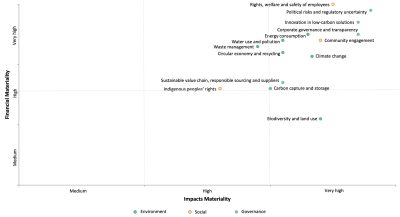
Work on the Double Materiality Assessment began in 2024, and this effort is a prerequisite for the implementation of sustainability reporting according to the European CSRD (Corporate Sustainability Reporting Directive), European Sustainability Reporting and an Information Standard in the field of sustainability and climate issues, ESRS (European Sustainability Reporting Standards). The purpose is to map Norðurál’s most important sustainability focuses, taking into account internal and external perspectives on sustainability in the operations. The materiality analysis addresses the main sustainability risks in the operations and explores which factors in the environment and society have the greatest impact on Norðurál’s finances.
The materiality of sustainability factors is assessed to map the impact of the operations on the environment, society and economy. The results of the risk assessment are subsequently incorporated into Norðurál’s general risk assessment, which is intended to reduce the likelihood of adverse situations arising. The results of the materiality analysis form the basis of Norðurál’s Annual and Sustainability Report.
List of material aspects ESRS IRO-2